Short answer: Teknoloji ve Tasarım (Technology and Design) is a required course taught 2 class periods a week in grades 7 and 8 of middle schools in Türkiye. Students look into a need or a problem, develop ideas, draw sketches, make a model or a product and present their product. The course takes place in the workshop and at school, and no homework is given. What students learn during the process matters more than a flawless product. In 2026-27, grade 7 classes follow the new curriculum, while grade 8 classes follow the 2018 curriculum.
Which grade follows which curriculum in 2026-27?
Under the decision of the Talim ve Terbiye Kurulu (Board of Education) dated May 13, 2026, the new Teknoloji ve Tasarım curriculum is being phased in from 2026-27, starting with grade 7. The 2018 curriculum is being phased out the same way. So:
- Grade 7: New curriculum. 9 units, 31 learning outcomes, 72 class periods.
- Grade 8: The 2018 curriculum continues. The new grade 8 curriculum will start in 2027-28.
The draft yearly plans published by the Ministry follow this split too: the grade 7 plan is based on the new curriculum, and the grade 8 plan on the old one. When you download a plan or an activity online, check which curriculum it was prepared for.
Grade 7: units and hours
| Unit | Class periods | What the student produces (the curriculum's suggested performance task) |
|---|---|---|
| 1. Learning Technology and Design | 4 | Examining and evaluating a product around them against criteria they set |
| 2. Basic Design | 6 | An original product made with design elements and principles, and a short explanation of the design decisions |
| 3. Design-Focused Process | 10 | Examining an industrial product for ergonomics, function, aesthetics and sustainability, and an improved design proposal (sketch and short text) |
| 4. Computer-Aided Design | 8 | A poster, brochure, video or digital presentation that presents their design, revised with feedback |
| 5. Architectural Design | 8 | A home design suited to a different climate and geography, a drawing or model, a presentation |
| 6. From Nature to Design | 8 | A drawing or model draft of a nature-inspired design, and a second version based on peer feedback |
| 7. Energy Conversion and Design | 8 | A draft of a product powered by renewable energy, and a process portfolio kept throughout the unit |
| 8. Integrated Learning: STEAM | 10 | A project proposal for an environmental problem using a STEAM approach |
| 9. Artificial Intelligence and Smart Products | 8 | A brand identity set for an organization made with AI tools (logo, colors and poster), and a process portfolio |
| School-based planning | 2 | Research, a field trip, a project or local work chosen by the subject team |
| Total | 72 |
The curriculum calls for at least one performance task in every unit. The tasks in the table are the curriculum's suggestions. You can also choose a different task that assesses the same learning outcome.
What happens in class, unit by unit?
1. Learning Technology and Design (4 periods)
Students question concepts such as finding (buluş), invention (icat), discovery, technique, design, technology, industry and STEAM. The curriculum suggests a concrete activity for this: the teacher brings a chair (industrial design), a poster (graphic design) and a model or image of a building (architectural design) to class. Students pick one, examine it from a technology and design point of view and discuss its impact on daily life. At the end of the unit, students choose a product from their surroundings, set criteria, measure the product against these criteria and reach a judgment.
This unit falls in the first weeks of the year. It is also a good time to talk about workshop rules and occupational health and safety. The curriculum asks that students watch public service announcements about occupational health and safety.
2. Basic Design (6 periods)
Design elements such as point, line, color, texture and form, and principles such as balance, rhythm, emphasis, contrast and proportion, are examined on a product or a work. Students reinterpret an existing product, build an analogy and finally make their own design. For this unit, the curriculum suggests traditional techniques such as drawing, painting, cutting, folding, tearing and gluing, making products from waste materials, and an emphasis on recycling. This is the easiest unit for schools with a limited workshop: cardboard, paper and clean waste materials brought from home are enough.
3. Design-Focused Process (10 periods)
The variables and criteria of a design problem are identified, and the problem is broken into parts. Students examine an everyday industrial product (such as a backpack, a pencil holder or a water bottle) for ergonomics, function, aesthetics and sustainability, and present an improved design proposal with a sketch and a short text. Making time for sketching in this unit makes all the later units easier.
4. Computer-Aided Design (8 periods)
Students move their designs into a digital environment with 2D and 3D design programs and prepare a poster, brochure, video or digital presentation that presents their design. The curriculum does not require any specific software. It asks that the school's computer lab and smart boards be set up so they can be used for this course. You may need to talk with the Bilişim Teknolojileri (Information Technologies) teacher at the start of the semester to book the computer lab. Most 2D and 3D design programs require an account. The age and parental consent warning in unit 9 applies here too: choose a tool that works without an account, or do the design as a class on the smart board with your own account.
5. Architectural Design (8 periods)
Different spaces are compared, and students examine how function changes a building. Students design a home they would like to live in, suited to different geographic areas and climate conditions, and turn it into a drawing or a model. For example, having students design a house for the same family in a cold, snowy mountain village and in a hot, humid coastal town makes the comparison easier.
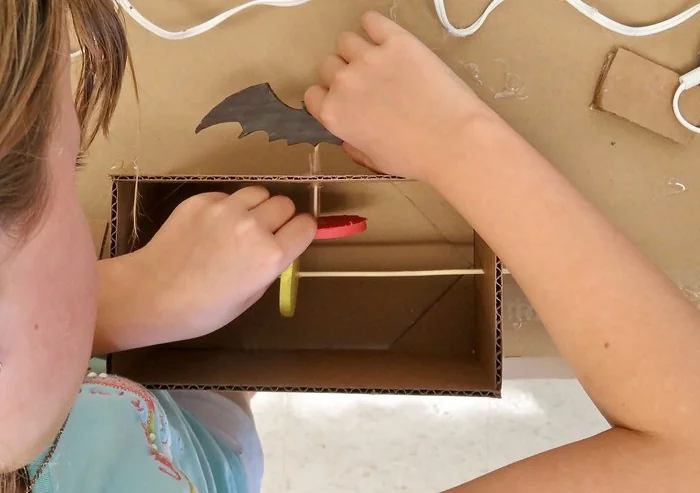
Cardboard model. Photo: fabola, CC BY-SA 2.0, Flickr, cropped.
6. From Nature to Design (8 periods)
Students observe the forms and structures of living things and natural objects, and draw a design idea from this observation (biomimicry). They draw a nature-inspired solution to an everyday problem or build a model of it, and prepare a second version based on the feedback they get from their peers. Starting with observations of leaves, pine cones or branches in the schoolyard needs no materials.
7. Energy Conversion and Design (8 periods)
Students research energy sources and how energy is converted, classify renewable and nonrenewable sources, and discuss how nonrenewable sources relate to global warming. At the end of the unit, students sketch a product that uses renewable energy. The curriculum suggests a process portfolio for this unit: observation notes, research, data tables, sketches, and for each stage a short reflection note asking "what did I do, why did I do it, what did I learn, what would I change."
In this unit the curriculum asks for a sketch and does not require building a product. For schools with a workshop, we have an optional extra suggestion: turning a propeller with a motor connected to a small solar panel. When the panel is shaded, the propeller slows down, which shows visibly that light is being turned into motion.
8. Integrated Learning: STEAM (10 periods)
Students examine the relationship between science, technology, engineering, art and math, and compare types of projects. They choose an environmental problem and prepare a project proposal showing the problem definition, the rationale, the target audience, the solution idea and the contribution of each discipline. This is the unit best suited to working together with science and math teachers. The curriculum also asks that the course be taught in cooperation with other subjects, science first among them.
9. Artificial Intelligence and Smart Products (8 periods)
Students question the concept of artificial intelligence, its types, its advantages and disadvantages, and examine smart products. In the performance task the curriculum suggests, students use AI tools to produce a brand identity set for an organization, made up of parts such as a logo, a color palette and a poster, and show the prompts they tried in their process portfolio.
There is one point to watch out for here: most grade 7 students are 12-13 years old, and many AI services set an age limit or require parental consent in their terms of use. Instead of having students open personal accounts, a safer approach is to use the tool as a class from the teacher's account on the smart board, with students writing their prompts on paper and trying them in turn. Read the terms of the tool you will use in advance, and set a rule that no personal information or student photos are uploaded to the tools.
Grade 8: the 2018 curriculum
In 2026-27, grade 8 classes follow the 2018 curriculum. The grade 8 units of this curriculum are:
- Developing Innovative Thinking and Protecting Ideas
- Computer-Aided Design and Smart Products
- Promotion and Marketing
- Visual Communication Design
- Product Development
- Engineering and Design
- From Nature to Design
- Transportation Technologies
- Designing My Original Product
- I Made This
In the 2018 curriculum, too, work is done at school and no homework is given. At the end of the year, students exhibit the products they choose at the "Bilim Şenliği" (Science Festival) organized by the school administration, teachers, students and parents.
Workshop, class size and class schedule
The rules that stand out in the new curriculum's implementation principles:
- Workshop: Each school should set up at least one space as a technology and design workshop, as far as its resources allow. Tools and equipment should be provided by the school administration. For schools without a workshop, options such as a mobile workshop are suggested.
- Materials: Activities should use tools and materials that are easy to find, low-cost, safe and simple.
- Class size: The number of students in the class should not exceed 25. Classes with more than 25 students are split into balanced groups, and each group keeps the same responsible teacher until the end of the year.
- Block period: For the course to be taught effectively, the timetable should be set so the two class periods run back to back without a break.
- No homework: Hands-on work is done at school, and no homework is given. Students carry out their tasks in the workshop.
- Process comes first: The experience and skills a student gains during the process come before the perfection of the product.
- Occupational health and safety: Tools are used safely, and students watch public service announcements on occupational health and safety.
- Field trips and guests: Inviting experts working in the field to the school and taking technical field trips are recommended. Legal permissions must be obtained for trips outside the school.
- Exhibition: At the end of the year, students exhibit their products at the "Bunu Ben Yaptım" (I Made This) event, attended by the school administration, teachers, students and parents, together with a "Fikirden ürüne sergisi" (From Idea to Product exhibition).
If cutting tools will be used (scissors, a craft knife), setting rules in the first weeks, such as using a cutting mat, handing out and collecting the tools under the teacher's supervision, and cutting away from the body, saves time in later units. Many schools do not give craft knives to students. If that is also your school's rule, you can do the cutting of thick cardboard yourself.
When building models, a hot glue gun needs at least as much care as cutting tools, because burns happen easily. Choose a low-temperature glue gun. Keep the gun standing on its stand in the middle of the table, and keep its cord away from walkways. Have cold water ready for burns.
How is assessment done?
- Written exam: Two written exams are held each semester. In school exams, questions are the kind where the student writes the answer.
- Hands-on exam: The subject team at the school decides which courses have a hands-on exam, and its format, number and length; the principal approves. Teknoloji ve Tasarım is one of the courses best suited for the subject team to discuss this option.
- Participation grade: Since the course meets 2 periods a week, two class participation grades are given each semester.
- Project: Students prepare at least one project a year. Students can choose any course they like for their project.
- Performance task: According to the curriculum, at least one performance task is given in every unit. The suggested tools are rubrics, checklists, self and peer assessment forms, a process portfolio and a product portfolio.
The curriculum asks students to note their observations in a notebook in some activities. We did not see a requirement for a separate "design notebook." A process portfolio does this job as a folder or file that keeps sketches and reflection notes in one place. Store the portfolios in a box or a cabinet in the workshop. A portfolio that goes home either does not come back or gets finished at home, which conflicts with the no-homework rule.
Is there a textbook?
For 2026-27, there is no student textbook for the Teknoloji ve Tasarım course. The curriculum itself also provides only a teacher's guide for this course. With the Talim ve Terbiye Kurulu decisions of August 2026, the "Ortaokul ve İmam Hatip Ortaokulu Teknoloji ve Tasarım Öğretmen Kılavuz Kitabı" (Technology and Design Teacher's Guide for Middle Schools and İmam Hatip Middle Schools) was accepted as a teaching resource. According to the directive on planned implementation, in courses that have a teacher's guide, the guide is used instead of a lesson plan.
Who teaches the course?
The Teknoloji ve Tasarım course is taught by a Teknoloji ve Tasarım teacher. Under the rules on teaching assignments, graduates of departments such as Industrial Technology Teacher Education, Work and Technical Education Teacher Education, Industrial Product Design and Industrial Design are appointed to this field.
Frequently asked questions
Is the new curriculum used in grade 8? No. In 2026-27, the 2018 curriculum continues in grade 8. The new curriculum started with grade 7.
Is a large class split? According to the curriculum, classes with more than 25 students should be split into groups, and the same teacher should be responsible for each group throughout the year.
Can I have students build models at home? According to the curriculum, no. Hands-on work is done at school, and no homework is given. A model made by the family at home does not show the student's process, and it creates a gap between students who have the means and those who do not.
We don't have a workshop. What can I do? Most of the Basic Design, Design-Focused Process, Architectural Design and From Nature to Design units can be done in the classroom with paper, cardboard and waste materials. For units that need computers, book the information technologies classroom in advance. You can give the school administration a list of needs, reminding them of the curriculum's provision on workshops and mobile workshops.
Is the end-of-year exhibition required? The curriculum lists students exhibiting their products at the end of the year at the "Bunu Ben Yaptım" event among its implementation principles. Getting the exhibition onto the school calendar at the start of the semester saves you from looking for a place and time in the last weeks.
Sources
- Teknoloji ve Tasarım Dersi Öğretim Programı (Technology and Design Curriculum, grades 7 and 8), TYMM (Türkiye Century Education Model), PDF. tymm.meb.gov.tr
- Tebliğler Dergisi (official bulletin), June 2026, Talim ve Terbiye Kurulu decision no. 48 dated 13/05/2026. dhgm.meb.gov.tr
- Teknoloji ve Tasarım Dersi Öğretim Programı (grades 7-8), 2018. mufredat.meb.gov.tr
- TYMM middle school Teknoloji ve Tasarım draft yearly plans. tymm.meb.gov.tr
- Weekly timetable for primary and middle schools, Talim ve Terbiye Kurulu decision no. 4 dated 09/05/2025. ttkb.meb.gov.tr
- Regulation on Preschool Education and Primary Education Institutions, article 22. mevzuat.gov.tr
- Ministry of National Education (MEB) Assessment and Evaluation Regulation, article 5. mevzuat.gov.tr
- Tebliğler Dergisi, August 2026 supplement (list of teaching resources). dhgm.meb.gov.tr
- Eğitim Öğretim Çalışmalarının Planlı Yürütülmesine İlişkin Yönerge (Directive on the Planned Implementation of Education Work), article 6. mevzuat.meb.gov.tr
- Öğretmenlik Alanları, Atama ve Ders Okutma Esasları (Teaching Fields, Appointment and Teaching Assignment Rules). ttkb.meb.gov.tr
Sources accessed: October 6, 2026.