Short answer: In 2026-27, the new curriculum applies to students who choose the Robotik Kodlama (Robotics Coding) elective course for the first time. So the first written exam of semester 1 mostly assesses the curriculum's first theme: robotics concepts, ethics, safety and privacy, algorithms, flowcharts, testing and debugging. In school written exams, students must write the answers themselves, which means multiple-choice questions are not used. Below is a 7-question sample exam we prepared from the learning outcomes of the new curriculum, with a scored answer key and a topic and question map.
Before preparing this sample, we reviewed the robotics coding exams shared online. Every one we found was either prepared for the old 2023 curriculum, or it was unclear which curriculum it was prepared for. These exams often ask about topics that are not in the first theme of the new curriculum. We cover this separately below.
When is exam 1 held?
Under the MEB (Ministry of National Education) Assessment and Evaluation Regulation, the first exam of semester 1 is held between the last week of October and the first week of November. According to announcements quoting the Ministry's 2026-27 exam calendar, the window for semester 1, exam 1 in school exams is November 2-13, 2026. The exact date is the calendar your school announces in e-Okul.
The school year started on September 14, 2026. But in many schools the first week goes to choosing electives, so by the exam about 6-8 weeks will have been taught, which at 2 periods a week is 12-16 class periods. The curriculum gives Theme 1 6-8 class periods. This means all of Theme 1 and part of Theme 2 will be covered by the exam. Also take into account any classes that fall on October 29.
Written exam rules in brief
Robotik Kodlama is a course that meets 2 class periods a week. In middle school, these rules apply to it:
- Number of exams: Two written exams are held each semester.
- Participation grade: Since the course meets 2 periods a week, two class participation grades are given each semester.
- Question format: School exams, other than national or province-wide common exams, use questions whose answers the student writes. So open-ended or short-answer questions are used instead of multiple-choice tests.
- Time: An exam lasts at most one class period.
- Common exam: If the course is taught in more than one section at the school, the exam is common to all of them.
- Topic and question map: Questions for common exams held at school are prepared according to a topic and question distribution table. These tables are drawn up by the province subject teams together with the assessment and evaluation centers. For basic education, the Ministry's 2026-27 semester 1 tables were published only for Turkish, math, science, social studies, religious culture and English. For Robotik Kodlama, check the website of your province's assessment and evaluation center. The table below is a suggestion you can use if there is no province table.
- Answer key: Questions are graded with a scored answer key, and open-ended questions with a rubric. In single-section classes, the regulation requires the answer key to be prepared with its points and kept on file.
- Hands-on exam: The subject team at the school decides which courses have a hands-on exam, and its format, number and length; the principal approves. For Robotik Kodlama, this is an option worth discussing with your subject team.
- Semester grade: The average of the project grades and the average of the participation grades are added together and divided by two. The result is added to the two exam grades and divided by three.
Students who chose the course last year and are taking it a second time this year may be in the transition period while the old curriculum is phased out. Clarify with your school administration which curriculum these students will be assessed on. The sample in this post is for students who are choosing the course for the first time and taking Level 1 of the new curriculum.
What to watch for in ready-made exams online
Most of the robotics coding exams shared on teacher websites contain topics from the old curriculum. Topics that are not in Theme 1 or Theme 2 of Level 1 of the new curriculum, and so should not be on the first exam:
- The history of robots, inventors' names and years.
- Types of programming languages and examples of text-based languages.
- Data types (numeric, character, logical) and AND/OR operators. In the new curriculum, simple logical operators appear as a prerequisite for Theme 3.
- Compilers, interpreters and similar concepts. These are not in Level 1; compiling code comes in Theme 2 of Level 2.
- Electrical circuits, types of boards, and circuit components such as resistors and LEDs. These are the topic of Theme 3 (Robotic Circuit Design).
- Menu names of a specific software or kit. The new curriculum does not require any brand or product.
Another problem we see in ready-made exams is that most questions ask for a definition in the form "What is ...?" The first theme of the new curriculum, however, asks students to turn a problem into an algorithm, show it with a flowchart and test the algorithm with sample inputs. The exam needs to assess this too.
Suggested topic and question map
| Question | Learning outcome | What is assessed? | Points |
|---|---|---|---|
| 1 | RK1.1.1 | The sensor concept; how sensing, deciding and acting relate | 10 |
| 2 | RK1.1.2 | Identifying a privacy risk and a physical safety risk in an application and suggesting a precaution | 12 |
| 3 | RK1.1.2 | Telling personal data apart, evaluating an application from an ethical point of view | 10 |
| 4 | RK1.1.3 | Identifying a problem's input and output, listing the process steps | 15 |
| 5 | RK1.1.3 | Showing the process steps with a flowchart | 25 |
| 6 | RK1.1.4 | Testing an algorithm with sample inputs, debugging the error | 18 |
| 7 | RK1.2.2 | Using code blocks and code flow in a block-based environment | 10 |
| Total | 100 |
To build this map, we estimated, one by one, how long a grade 5 student needs to read and answer each question. Eight questions take 45-50 minutes including reading, which does not fit in one class period. That is why the sample exam has 7 questions. At the end of the post there is also a backup question that assesses where robotic systems are used. You can swap it in for question 1; it is worth the same points.
If your class has not started Theme 2 before the exam, or has not yet covered the repeat block, remove question 7. Add 5 of its 10 points to the "branches" criterion in question 5, and 5 to part b of question 6.
If you drew a chart in class like "turn on the garden light when it gets dark," question 5 will be almost the same as that, and it will test memory rather than understanding. In that case, change the context, for example "if the doorbell button is pressed, the bell rings; if not, it does not ring."
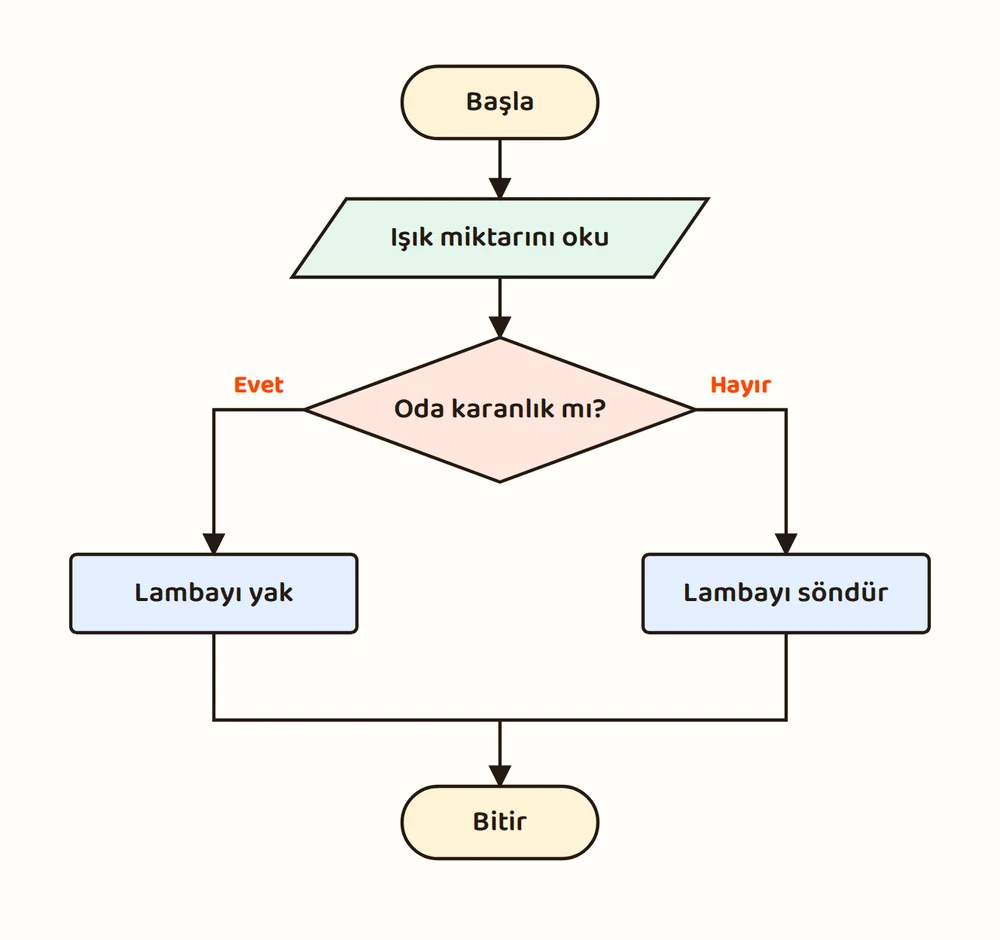
The two images in this post, the Question 7 block view and the Question 5 sample solution, show the Turkish originals.
Sample exam: 2026-27 Robotik Kodlama Level 1, semester 1, exam 1
Name: .................................... Class: .......... Number: ..........
Time: 1 class period. The points for each question are shown next to it.
Question 1 (10 points)
A supermarket's automatic door opens when someone comes near it. When no one is left in front of the door, it closes by itself a few seconds later.
a) What is the general name of the part that lets the door tell that someone is in front of it? (2 points)
b) Write one sentence each describing what happens in the "sensing," "deciding" and "acting" steps of how this door works. (6 points)
c) If the part you wrote in (a) breaks and senses nothing at all, what happens to the door? (2 points)
Question 2 (12 points)
A school is thinking about buying a guard robot with a camera and a microphone that patrols the hallways. The robot records everything it sees and hears and sends the recordings over the internet to a computer outside the school. During breaks, it moves on its own through crowded hallways.
a) Write one privacy risk in using this robot and suggest a precaution for this risk. (6 points)
b) Write one risk this robot creates for students' physical safety and suggest a precaution for this risk. (6 points)
Question 3 (10 points)
A group of students is designing a system that recognizes students entering the classroom by their faces on a camera and takes attendance automatically. The system records the following information:
- The student's first and last name
- A photo of the student's face
- The time each student enters the classroom
- The temperature of the classroom
a) Which of these are personal data? Write their numbers. (6 points)
b) Whose permission must be obtained before this system starts being used? Write one sentence. (4 points)
Question 4 (15 points)
The flowers growing in pots in the school garden sometimes go without water. Students want to design a robotic system that turns on a water pump when the soil dries out and stops the pump when the soil is wet enough.
a) What is the system's input in this problem? (2 points)
b) What is the system's output in this problem? (2 points)
c) Write, in order, the process steps the system needs to work. Write at least four steps. (11 points)
Question 5 (25 points)
A smart night light measures the amount of light in the room with a light sensor. If the room is dark, the lamp turns on; if the room is not dark, the lamp turns off.
Draw the algorithm of this night light, running once, as a flowchart in the empty space below. Use the flowchart symbols correctly.
Note to the teacher: leave about half a page of empty space on the paper for this question.
Question 6 (18 points)
A student wrote the algorithm below for a trash can whose lid opens by itself when a hand comes near. The distance sensor on the lid measures the distance between the sensor and the hand in centimeters.
- Start.
- Read the distance from the distance sensor.
- If the distance is greater than 20 cm, open the lid.
- Wait 3 seconds.
- Close the lid.
- End.
a) Try the algorithm with the two sample inputs below. For each input, write what happens to the lid. (6 points)
| Sample input | What happens to the lid? |
|---|---|
| The hand is 10 cm from the sensor | |
| No one is in front of the can, the sensor measures 80 cm |
b) Write the number of the wrong step in the algorithm and rewrite that step in its corrected form. (8 points)
c) To check that your corrected algorithm works properly, which sample input would you test it with again? What do you expect the lid to do with this input? (4 points)
Question 7 (10 points)
In a block-based coding environment, a pen character was given the code blocks below. The pen leaves a line wherever it moves.
when start clicked
repeat 4
    move 100 steps
    turn right 90 degrees
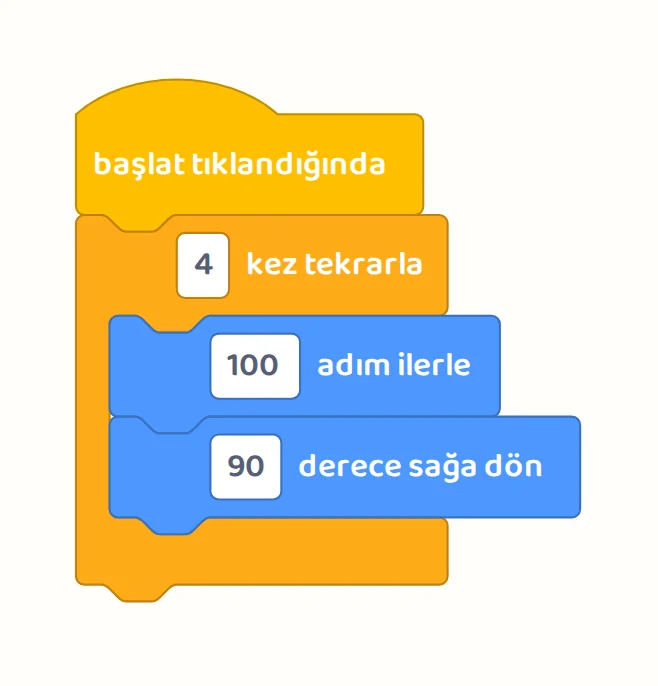
You can also put this block view on the exam paper instead of the code.
a) What shape is drawn on the screen when this code runs? (4 points)
b) Which value in which block would you change to draw the shape bigger? (3 points)
c) If there were no "repeat" block, how many blocks would the code need, one under the other, to draw the same shape? Do not count the "when start clicked" block. (3 points)
Good luck.
Backup question (10 points, can replace question 1)
Below are five robotic systems used in different places. Write each system's letter in the blank next to the area where it is used. More than one system can go in a group.
A) Robot vacuum
B) Robotic arm that helps a doctor during surgery
C) Robot that milks cows
D) Robotic arm that welds in a car factory
E) Robot that carries medicine to patient rooms in a hospital
Home: ....................
Health: ....................
Agriculture and livestock: ....................
Industry: ....................
Answer key and scoring
For the open-ended questions, the answers below are examples. Answers the student writes in their own words that carry the same meaning get full points.
Question 1 (10 points).
- a) Sensor. 2 points. More specific names such as "motion sensor" or "distance sensor" are also accepted.
- b) 2 points per step:
- Sensing: the sensor detects that someone has come in front of the door.
- Deciding: if someone is there, the decision is to open the door; if no one is there, to close it.
- Acting: the motor opens or closes the door.
- c) The door does not notice the person coming near and does not open. 2 points. Answers that say the door stays open all the time and give a reason can also be accepted.
Question 2 (12 points). In each part, 3 points for the risk and 3 points for a precaution that fits the risk. If the precaution is not related to the risk written, no points are given for the precaution.
- a) Privacy. Sample risk: students' images and conversations are recorded without permission, or the recordings that are sent may fall into other people's hands. Sample precautions: turning off microphone recording, letting only authorized people see the recordings, deleting recordings after a set time, sending recordings encrypted, informing students and parents.
- b) Physical safety. Sample risk: the robot may bump into a student in a crowded hallway, knock someone down or injure them. Sample precautions: the robot stops when it detects an obstacle, moves slowly during breaks, or does not run at all. An answer about the recordings being stolen gets no points in this part, because that is a privacy risk.
Question 3 (10 points).
- a) 1, 2 and 3. 2 points for each correct number. If number 4 is written, 2 points are taken off; the score does not go below zero. Note: the time a student enters the classroom may look like just a number on its own, but it is personal data because it is recorded linked to a specific student. Discussing this distinction in class is the point of the question.
- b) The parents' permission, 2 points. Second, the school administration's permission, or informing the students themselves and getting their permission, 2 points. An answer that says "the students' and parents' permission" gets full points. An answer that names only one person or body gets 2 points.
Question 4 (15 points).
- a) The moisture level of the soil, that is, the value coming from the moisture sensor. "Whether the soil is dry or wet" also gets full points. 2 points.
- b) The water pump running or stopping. 2 points. An answer that says "watering the flowers" gets 1 point.
- c) Sample steps: (1) Read the value from the soil moisture sensor. (2) Check whether the soil is dry. (3) If it is dry, turn on the pump. (4) When the soil is wet, stop the pump. (5) Measure again after a while. 2 points for each step written in the right order, up to 8 points. 3 points if the steps as a whole solve the problem. If there is no measuring step at all, these 3 points are not given.
Question 5 (25 points). Rubric:
| Criterion | Points |
|---|---|
| Start and end are shown with an oval symbol | 3 |
| There is a step that reads the value from the light sensor (input). Drawing it as a parallelogram or a rectangle is accepted | 5 |
| The decision step is shown with a diamond and the right question | 6 |
| The branches are right: "turn on the lamp" when dark, "turn off the lamp" when light | 8 |
| The arrows show the direction of flow correctly | 3 |
Sample solution: Start, then "read the amount of light," then the decision "Is the room dark?" If yes, "turn on the lamp"; if no, "turn off the lamp." Both branches connect to End. A chart that asks "Is the room bright?" and connects the branches the other way around accordingly is also correct and gets full points. If the student added a loop that goes back to the measurement even though the question did not ask for one, and the chart is correct, it gets full points.
Question 6 (18 points).
- a) 3 points per row.
- 10 cm: the lid does not open, because 10 cm is not greater than 20 cm.
- 80 cm: the lid opens, because 80 cm is greater than 20 cm. So the lid opens when no one is there.
- b) The wrong step is step 3. 2 points. Corrected form: "If the distance is less than 20 cm, open the lid." 6 points.
- c) For example, 10 cm. The lid is expected to open. Or with 80 cm, the lid is expected not to open. 2 points for the input, 2 points for the expected result.
Question 7 (10 points).
- a) A square. 4 points.
- b) I make the number 100 in the "move 100 steps" block bigger. 3 points.
- c) 8 blocks (4 "move," 4 "turn"). 3 points.
Backup question (10 points). 2 points for each correct placement.
- Home: A.
- Health: B and E.
- Agriculture and livestock: C.
- Industry: D.
When you write questions yourself
The question writing guide MEB published for the Türkiye Yüzyılı Maarif Modeli (Türkiye Century Education Model) is written for multiple-choice questions. But its principles for context and question stems also apply to open-ended questions. Adapted to a robotics exam, these stand out:
- The context should not be decoration. If you can answer the question without reading the context, the context is not doing its job. In question 6 above, the wrong step cannot be found without reading the algorithm.
- The context should suit the age group and be a situation everyone knows. Like an automatic door, a night light or the school garden.
- The question stem should ask for one task. If more than one task is needed, split it into parts a, b, c and write the points for each part.
- Do not use subjective phrases like "in your opinion." Instead of "In your opinion, is this robot safe?" write "Write one safety risk of this robot."
- Questions should not depend on each other. A question that starts "Using what you found in the previous question..." punishes twice a student who could not answer the first question.
- In a negative question stem, emphasize the negative word. Like "Which one is not personal data?" Do not use double negatives.
- An image should give new information. Do not add decorative robot pictures. Use images that carry information needed for the question, such as a flowchart or a screen sketch.
- Do not use brand names. The curriculum does not require any specific software or kit. The exam should also say "block-based environment" instead of naming an environment.
For students with an individualized education program
The number of questions can be reduced while keeping the same learning outcomes. In the flowchart question, the symbols can be drawn in advance and the student asked only to fill in the boxes. In question 6, the table can be given ready-made, and the student expected to write only "opens / does not open." Make adaptations based on the decision of the BEP (individualized education program) development unit at your school.
Assessment beyond the written exam
The assessment and evaluation section of the curriculum asks for a focus on the process, not only the product, and recommends rubrics, observation forms, self and peer assessment, and process-based performance tasks. In a hands-on course like Robotik Kodlama, a written exam shows only part of what a student does. A group activity in class where students swap flowcharts and look for errors is a good chance to observe for the participation grade.
Sources
- Ortaokul Robotik Kodlama Dersi Öğretim Programı (Middle School Robotics Coding Curriculum), PDF (learning outcomes, time table, assessment and evaluation). tymm.meb.gov.tr
- Talim ve Terbiye Kurulu (Board of Education), decision on the Robotik Kodlama curriculum, August 7, 2026 (decision annexes). dhgm.meb.gov.tr
- Ministry of National Education Assessment and Evaluation Regulation, articles 4, 5 and 6 (Resmî Gazete, the Official Gazette, September 9, 2023). mevzuat.gov.tr
- Regulation on Preschool Education and Primary Education Institutions, articles 20, 22 and 27. mevzuat.gov.tr
- General Directorate of Assessment, Evaluation and Examination Services, Semester 1 Topic and Question Distribution Tables (2026-2027). odsgm.meb.gov.tr
- Ministry of National Education, 2026-2027 school year calendar. meb.gov.tr
- Türkiye Yüzyılı Maarif Modeli, Context-Based Multiple-Choice Question Writing Guide (March 2026). tymm.meb.gov.tr
Sources accessed: October 6, 2026.